The archaeological site of Ingapirca represents the most significant physical record of pre-Columbian history in Ecuador. Situated in the high-altitude terrain of the Cañar province, the complex serves as a structural timeline detailing the eventual assimilation of the indigenous Cañari civilization by the expanding Inca Empire. Unlike many military fortifications found throughout the Andes, Ingapirca functioned primarily as a sophisticated religious, administrative, and solar observation center. Its foundational stonework and subsequent architectural expansions provide critical evidence of a unique cultural syncretism, blending native matriarchal traditions with imperial patriarchal governance.
Understanding the scale and precision of these ruins requires recognizing the site’s importance within the broader network of the ancient Andean world. Ingapirca operates as one of the major intersection points of the Great Inca Road, or Qhapaq Ñan. This monumental thoroughfare connected a demanding two-to-three-day trekking route originating from the town of Achupallas, located at an elevation of 3,000 meters, traversing past the sacred, snake-shaped Culebrillas Lagoon directly into the administrative heart of the complex. To preserve the extensive structural data of these trade routes and the main ruins, a comprehensive heritage project funded by CyArk and the INPC was executed between 2021 and 2022. The entire Ingapirca complex was digitally documented utilizing nearly 10,000 high-resolution photogrammetry images, ensuring the site’s exact dimensions remain available for future archaeological analysis.
The Convergence of Two Empires: Cultural and Architectural Syncretism
The pre-colonial context of the Cañar province is defined by the enduring presence of the Cañari people, who inhabited the region long before the arrival of the Inca forces led by Tupac Yupanqui and later Huayna Capac. The initial interactions between these two distinct civilizations were marked by fierce resistance, eventually leading to a strategic alliance and a shared settlement at Ingapirca. This convergence is physically manifested in the dual nature of the site’s architecture. The archaeological evidence reveals a remarkable blending of Cañari matriarchal and lunar traditions with the Inca’s strict patriarchal and solar worship protocols. This syncretism set the stage for a unique spatial layout, where older, foundational structures dedicated to lunar tracking sit mere meters away from imperial temples calibrated to solar solstices.
Visitors seeking a broader context on how this historical convergence impacts modern Ecuadorian geography should review our guide on Exploring Ecuador: Nearby Attractions, which contextualizes the surrounding Azuay and Cañar provinces. The shared occupation of Ingapirca allowed both cultures to maintain distinct religious practices while operating within a unified administrative hub. This peaceful or heavily managed coexistence is highly unusual in the context of typical Inca conquests, making the site an essential subject for modern anthropologists.
The Blueprint of Fusion
The defining feature of this architectural fusion is the Elliptical Temple of the Sun, commonly referred to as El Castillo. It holds the distinction of being the only elliptical Inca temple in South America. The structure was engineered around a large, pre-existing natural rock, heavily utilizing greenish andesite stone blocks alongside local volcanic rock. The temple showcases classic imperial Inca ashlar masonry. The greenish andesite stones were hand-carved with extraordinary precision, employing mortarless joinery that allowed the massive blocks to fit together perfectly without any adhesive materials.
This masterwork of engineering was not merely aesthetic; it served a highly specific astronomical purpose. The temple’s major axis is aligned almost exactly east to west. During the June solstice solar alignment, which occurs around June 20 or 21, sunlight pierces the structure to directly illuminate specific interior niches. This precise celestial calibration was utilized by the imperial elite to mark the beginning of the agricultural Inti Raymi festival. For a closer look at the exact mechanics of these alignments, see our detailed breakdown of The Temple of the Sun & Landmarks.
Adjacent to the primary temple are the Aposentos, a series of enclosed rooms historically utilized by high priests and imperial nobility. These chambers feature distinctive trapezoidal double-jamb doorways. In standard Inca architectural grammar, the double-jamb design was exclusively reserved to denote high status and physically restrict access to elite or deeply sacred spaces. Exploring these restricted corridors is often a highlight for those booking a Private Tour from Cuenca to Ingapirca Ruins with Lunch, allowing for a deeper understanding of the hierarchical layout.
The complex also integrates natural topography with ritual function, notably through the Intihuayco (Ravine of the Sun) and the Ingachungana, a carved stone channel believed to be used for ritual baths or ceremonial games. Furthermore, the site functioned as an active religious community, housing the remains of the Acllahuasi, or House of the Virgins of the Sun. Specialized workshops were attached to these quarters, explicitly designed for brewing chicha, a fermented ceremonial corn drink essential for state-sponsored rituals. You can learn more about the legacy of these ancient ingredients in our Guide to Traditional Andean Cuisine.
The Pilaloma Complex: Exploring the Cañari Foundations
Located deliberately on the south side of the main ruins, the Pilaloma complex serves as the foundational footprint of the indigenous Cañari people. This sector marks the original pre-Inca settlement and provides a stark architectural contrast to the polished ashlar masonry of the imperial additions. Just before entering the Pilaloma sector, visitors can clearly observe the distinct shift in foundational stonework. The transition from the meticulously carved andesite of the upper terraces to the rougher, mortar-bound river stones of the Cañari lower levels visually separates the earlier settlement from the later imperial expansions.
Approaching this southern boundary, visitors will encounter five circular stone structures known as collcas. These sunken storage basins were utilized extensively by both the Incas and the native Cañaris for the bulk storage of vital agricultural products, primarily resilient grains like quinoa and corn. The collcas were engineered with natural ventilation systems to prevent rot, ensuring that the inhabitants of the complex could survive the region’s dry seasons and periods of scarcity. Due to the high elevation and steep gradients of these sectors, we highly recommend reading our guide on How to Avoid Altitude Sickness in the Andes prior to your arrival.
The Tomb of the High Priestess
The most profound archaeological discovery within the Pilaloma complex is the collective tomb of a high-status Cañari priestess. This excavation site offers a harrowing yet fascinating glimpse into the ritualistic burial rites of the pre-Inca inhabitants. The archaeological findings within the tomb revealed that the priestess was interred alongside 10 of her servants. Forensic evidence indicates that these servants were entombed alive, a sacrificial practice intended to ensure the priestess was attended to in the afterlife.
The wealth and status of the interred priestess were further confirmed by the presence of thousands of imported spondylus shells surrounding the burial site. The spondylus, or thorny oyster, was a highly venerated material in ancient Andean cultures, often valued more than gold. Because these shells are native to the warm coastal waters of the Pacific Ocean, their massive accumulation in a high-altitude Andean tomb illustrates the vast and sophisticated pre-colonial trade networks that the Cañari people commanded. Travelers eager to learn more about the region’s broader history often maximize their visit through an Ingapirca Ruins & Inca mountain face tour from Cuenca with Small Group, which provides expert narration on these specific trade routes.
The priestess’s tomb at the Pilaloma complex lies beneath a massive rock that allowed for complex astronomical calculations and likely served as a central sacrificial altar.
The site’s astronomical significance extends beyond the Temple of the Sun. Within the wider complex, archaeologists have identified specific stone alignments resembling an Intihuatana. Often translated as the “hitching post of the sun,” the Intihuatana was a vital ritual stone used by Inca priests as a highly accurate solar clock. By tracking the exact shadow cast by the stone during the solstices and equinoxes, agricultural administrators could calculate precise planting and harvesting dates, a necessity for surviving the challenging mountain climate.
Practical Logistics for Heritage Travelers
To ensure the physical conservation of these delicate structures, visitor access is heavily regulated. As of the 2025/2026 season, visitors are highly encouraged to reserve their entrance tickets online directly through the Instituto Nacional de Patrimonio Cultural (INPC) official portal. For online reservations, the $2 tickets must be secured at least 8 hours in advance to manage the strict 30-person capacity limit enforced per 45-minute guided turn, though walk-up physical tickets are still available at the gate subject to availability. You can find a complete breakdown of reservation protocols and operational hours on our Tickets & Tours page, as well as an overview of Visitor Rules & Guidelines which strictly prohibit touching the ancient stonework or flying unauthorized drones over the complex.
For independent travelers navigating the region to see these prominent Ecuador ruins, getting to the site requires precise logistical planning. The archaeological complex operates strictly from Wednesday through Sunday, remaining completely closed on Mondays and Tuesdays for site maintenance. Transportes Cañar operates direct public buses departing from the Terminal Terrestre in Cuenca. These direct routes depart at 9:00 AM exclusively on Fridays, Saturdays, and Sundays, with the return bus leaving Ingapirca promptly at 1:30 PM. The journey takes approximately 2.5 hours and costs around $3.50 to $4.00 USD per person. If you plan to explore this vital piece of Inca Ecuador on a Wednesday or Thursday, you must take a northbound bus to the town of Cañar or El Tambo, then transfer to a local transit bus running to the Ingapirca village. Comprehensive bus schedules and driving directions are available on our dedicated How to Get to Ingapirca Ruins transportation guide.
If you intend to stay overnight and experience the Andean landscape at dawn, the Posada de Ingapirca is situated just 300 to 500 meters east of the main ruins. This beautifully restored historic hacienda offers a cozy resting place directly along the ancient Inca Trail. The restaurant at the posada is renowned for serving traditional regional cuisine, providing travelers the opportunity to taste authentic roasted guinea pig and locally sourced organic vegetables before continuing their exploration of the Cañar province. For those planning a multi-day itinerary, be sure to review our Planning Your Visit guide to optimize your timeline and ensure you pack appropriately for the dramatic shifts in high-altitude weather.
The preservation of Ingapirca relies heavily on responsible tourism. The sheer volume of history contained within the elliptical walls and subterranean tombs requires constant maintenance against environmental degradation. Visitors interested in the long-term protection of the site should read our Conservation & Environment mandate, detailing how local communities manage tourism impact and enforce ‘Leave No Trace’ principles. Understanding the profound architectural fusion of the Cañari and Inca civilizations ensures that your visit is not just a visual tour, but an educational engagement with one of South America’s most vital ancient origins.
Essential Ingapirca Ruins Facts: Mythology, Astronomy, and Rediscovery
Beyond the primary architectural achievements, a deeper dive into Ingapirca ruins history reveals a complex layer of indigenous mythology and modern scientific discovery. The Cañari people trace their origins to the Legend of the Guacamayas. According to local oral traditions, after the earth deity Pachamama unleashed a catastrophic flood, two brothers survived by scaling a mythological mountain. They were saved from starvation by two brilliantly colored macaws (guacamayas) that transformed into women. These women married the brothers, becoming the progenitors of the Cañari civilization. Today, local indigenous women still wear bright reds and pinks to honor their macaw ancestors.
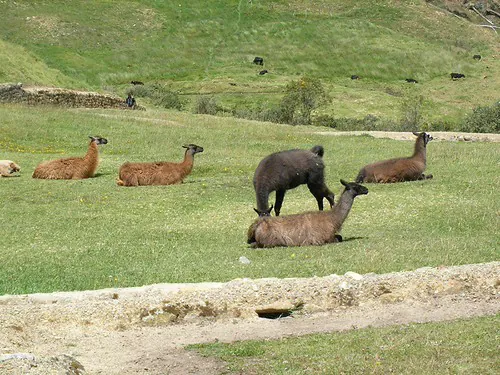
Another of the most compelling Ingapirca ruins facts centers on the site’s advanced astronomical tools. Near the main temple, visitors will find the Lunar Calendar Stones. These large, flat monoliths are carved with 28 distinct circular holes of varying sizes. The Cañari filled these depressions with water to track lunar reflections across the 28-day cycle, a critical method for precise agricultural planning in the unpredictable Andean climate. As you examine these ancient instruments, you will likely encounter the resident herd of free-roaming alpacas and llamas. Protected by Ecuadorian law as cultural heritage assets, these animals naturally graze the grounds, maintaining the pastoral atmosphere of the complex.
The timeline of the site’s rediscovery and preservation is equally complex. French scholar Charles-Marie de La Condamine provided the first scientific description of the ruins in 1739, long after the Spanish Conquistadors had pillaged many of the masterfully cut andesite blocks to construct colonial churches in Cuenca. While formal restoration began in the mid-20th century, conservation remains an ongoing challenge. Recent 2023 studies revealed that rigorous surface cleaning conducted in the 1990s inadvertently accelerated the microbial biodeterioration of the Temple of the Sun’s iconic green andesite blocks. This discovery has fundamentally shifted how archaeologists approach the physical maintenance of the ruins today.